 working
The short version
Quick Revision is Working’s direct conversation mode. Its job is to help a student move past a specific point of confusion: an unfamiliar term, a missing algebraic step, or a question whose wording is difficult to interpret. The product makes room for a concise answer, follow-up questions and attached study material, without first requiring a structured learning plan.
The central design choice is to make a response useful as a method the student can inspect. An answer alone tells you where to arrive. A short explanation of the transformation, assumption or rule makes it possible to question how you got there. That distinction shapes both the study instructions sent to the model and the way the interface renders the reply.
From question to explanation
A turn begins with the student’s message and any selected files. The server checks access to the conversation and its attachments, assembles recent messages, and adds Working’s study instructions. The context is bounded rather than an unlimited memory of everything a student has ever studied.
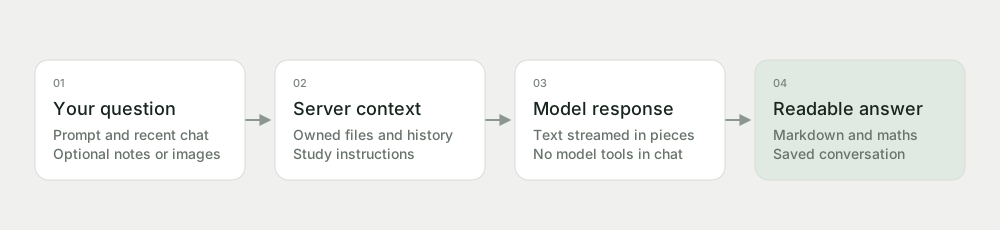
Text, images and PDFs take different paths into the model request. Images require a configured vision-capable model. PDFs are included as file content and use the provider’s file-parsing integration. This gives the response relevant material to work from, but it does not make extracted text or a model’s reading of a diagram automatically correct.
Quick Revision uses ordinary assistant text rather than Learn’s structured checkpoint tool. The server can stream the response as small text events, allowing the browser to show the answer as it arrives. A successful stream is then part of the saved conversation, so the student can ask about the exact line that caused difficulty.
An example: finding the missing step
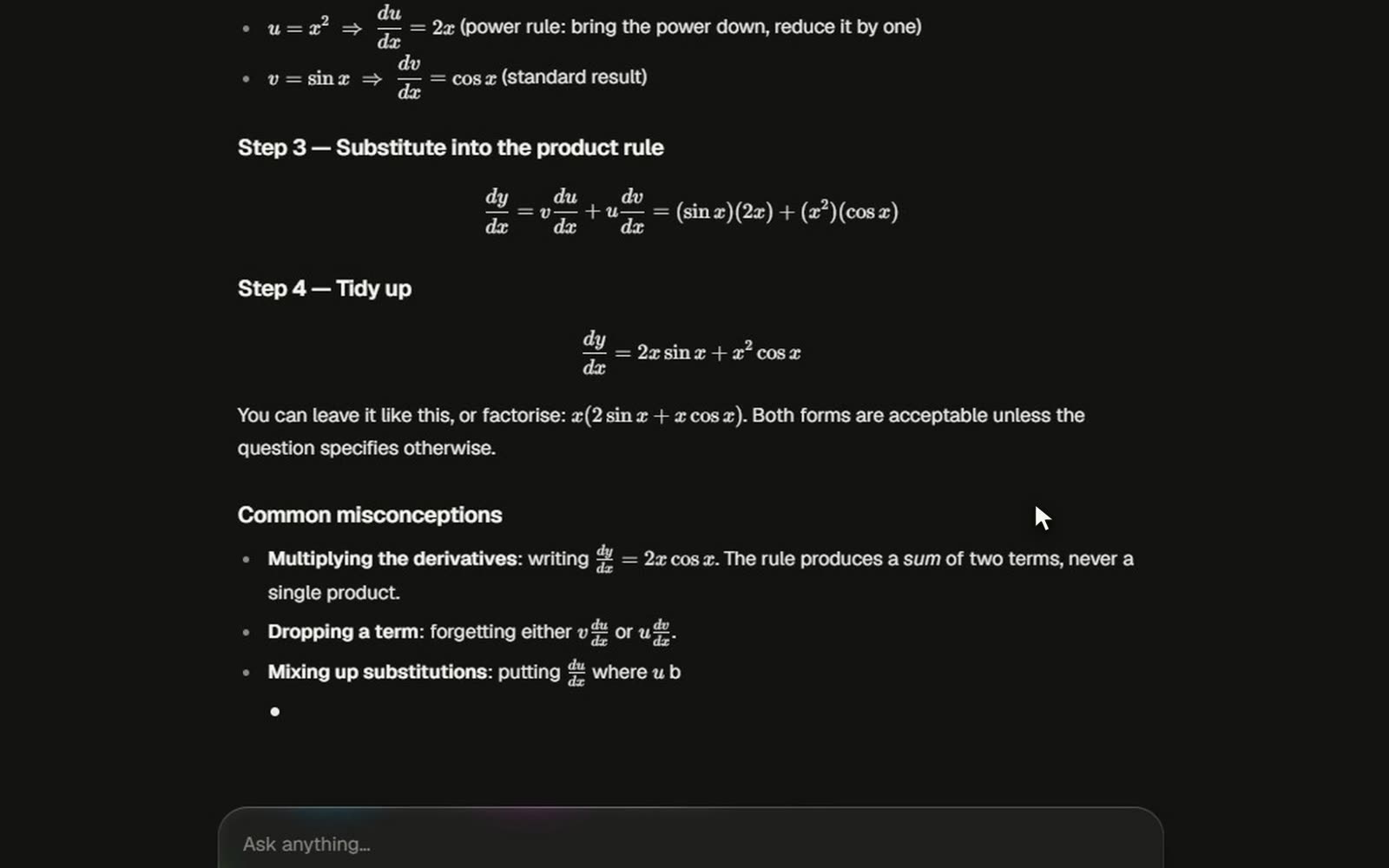
Consider a student who asks why the derivative of is not simply . The useful intervention is to identify the product, name the rule and show where the two terms come from. Multiplying the separate derivatives loses part of the relationship.
Recognise the structure. Two functions are multiplied.
Apply the product rule. Differentiate one factor at a time.
Substitute the derivatives.
The explanation should make the misconception discussable. A useful follow-up is to ask the student to identify the two factors in a nearby example before doing the differentiation. This proposed study routine goes beyond receiving a generated answer: it asks the learner to reconstruct the method.
How it is built
The application separates model access from the browser. The server constructs the request and holds provider credentials; the browser receives learner-facing content. Model selection is configurable, so this feature should be understood as an application workflow around a language model, rather than a proprietary model trained specifically for each exam board.
The reply uses Markdown for structure and LaTeX for mathematical notation. The rendering layer translates those formats into readable text and equations. Streaming is a delivery mechanism: it reduces the time before something is visible, but does not itself make the reasoning better or guarantee a shorter total wait.
| Layer | Responsibility |
|---|---|
| Conversation | Keep the question, recent replies and selected attachments together. |
| Server | Check ownership, assemble context and request a model response. |
| Stream | Deliver partial text and detect an interrupted or incomplete response. |
| Renderer | Display prose, lists and mathematical notation in the chat. |
The study instructions ask for British English, concise steps, useful hints and explicit uncertainty about official marking. Uploaded content is treated as study material rather than a source of application instructions. These are design constraints and safeguards; a model can still misread a question or produce a persuasive error.
Why expose the method?
Chi and colleagues’ study of students learning from worked mechanics examples linked more productive self-explanations with understanding and later problem solving. It offers a reason to invite students to explain a step in their own words, rather than only reread it. It does not test Working. Chi et al., 1989.
Research on worked examples also motivates making intermediate steps available to learners. Sweller and Cooper’s 1985 algebra study is part of that literature. Applying that idea to an AI interface is a design inference: the quality and appropriateness of each generated example still need to be checked. Sweller & Cooper, 1985; author publication record.
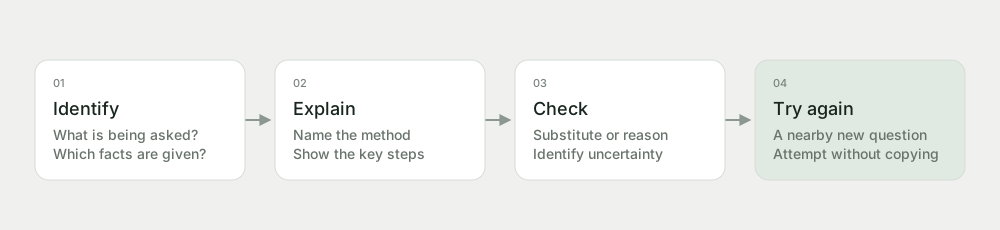
In practice, this suggests a simple sequence: read a short method, close or cover it, explain the key rule, then attempt a related question. Quick Revision supplies the conversational setting for that sequence. It does not currently enforce a delayed retrieval schedule or independently establish that the student has mastered the topic.
What needs checking
Fluent text can hide an incorrect assumption. A student should compare the explanation with the original question, check units and signs, and use a supplied mark scheme when official marking is relevant. Without that source, feedback is provisional. The ordinary chat workflow should not be described as a live, verified search of an exam-board library.
Useful evaluation would separate answer accuracy, method correctness and independent transfer. A correct result copied from a worked answer does not establish that a student can solve a new problem. Future testing should include unseen questions, delayed attempts and reviews by subject specialists, with the question set and scoring criteria disclosed.
References and implementation notes
- Chi, M. T. H., et al. (1989). Self-Explanations: How Students Study and Use Examples in Learning to Solve Problems. Cognitive Science, 13, 145–182.
- Sweller, J., & Cooper, G. A. (1985). The Use of Worked Examples as a Substitute for Problem Solving in Learning Algebra. Cognition and Instruction, 2, 59–89. DOI: 10.1207/s1532690xci0201_3. Listed in Sweller’s university publication record.
Implementation inspected for this article: the conversation request and streaming paths in server.mjs, and the browser’s renderer.js and stream.js. Model output and configuration can change; examples here explain the architecture, not a fixed promise of response wording.